Personalized plastic surgery, laser & anti-aging care in Haeundae, Busan
en-US

Under-Eye Fat Correction Korea: Two Procedures Compared
Under-eye fat correction and under-eye fat contouring sound alike but differ in approach. How TAE Plastic Surgery Clinic in Busan tells them apart.

Under-Eye Fat Correction in Korea: How Two Similar-Sounding Procedures Differ

Medically reviewed by Dr. Kim Ki-Tae, Board-Certified Specialist in Plastic Surgery, issued by the Korean Society of Plastic and Reconstructive Surgeons
If you are researching under-eye fat correction in Korea, you have probably also come across under-eye fat contouring, and the two names are easy to confuse. They are separate services at TAE Plastic Surgery Clinic in Haeundae, Busan, and they are chosen for different starting anatomy rather than being interchangeable options for the same problem. This article explains what each one sets out to do, how the decision between them is made, and what the weeks after surgery generally involve.
Two names, two different operations
Dr. Kim Ki-Tae has addressed this confusion directly in a published statement: "Under-eye fat repositioning and under-eye fat correction have similar names, but they differ in surgical approach and in process. Because every patient's anatomical structure and under-eye condition is different, it is important to set an appropriate surgical plan through sufficient consultation and diagnosis."
That is worth dwelling on, because a great deal of online content about Korean eye surgery treats every under-eye procedure as one thing with several marketing names. It is not. The approach, the tissue that gets moved, and the problem each technique is built to solve are genuinely different, and picking the wrong one is not a matter of preference — it is a mismatch between the operation and the face it is performed on.
What under-eye fat correction sets out to do
Under-Eye Fat Correction is the service TAE Plastic Surgery Clinic uses to address under-eye fat and the shadowing that comes with it, working through an incision on the inner conjunctival surface of the eyelid rather than the skin.
What distinguishes the clinic's method is that removal and grafting happen together. The protruding orbital fat is taken down, and fat harvested from another area is then placed back into the under-eye region. This matters because the two problems patients arrive with are usually not one problem. A person can have a bulge and a hollow at the same time — the fat pad pushes forward while the groove beneath it sits back — and simply removing the bulge can leave the hollow looking deeper than before.
Candidacy is assessed on the anatomy rather than on the complaint. The clinic looks for orbital fat protruding forward, or the combined pattern in which the area reads as bulging and hollow at once, and considers eye shape, the amount of fat present and skin thickness together. The reason for that combined assessment is structural: the tissue around the eye is thin and carries a dense concentration of blood vessels and nerves, so the margin for a technique that does not fit the anatomy is small.
What under-eye fat contouring sets out to do
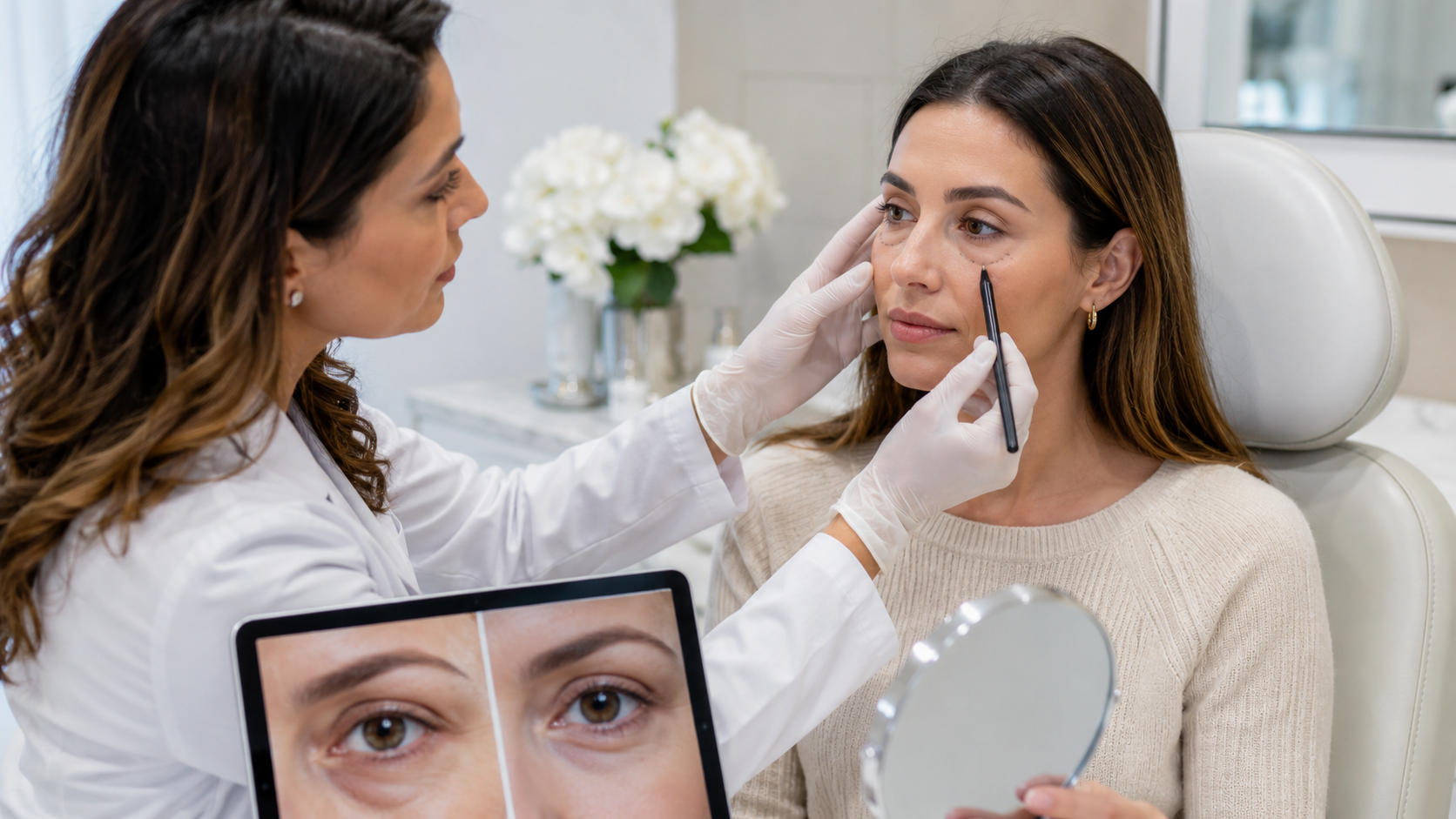
Under-Eye Fat Contouring is listed separately, and the clinic describes it as an approach that addresses facial aging signs by performing under-eye fat correction and autologous fat grafting at the same time. It is presented as relevant regardless of age for people whose concern is a congenital lack of volume, a sunken facial appearance, or deep dark circles under the eyes.
Candidacy here is described in terms of prominent lower-eyelid or orbital fat, under-eye bags, tear-trough depression, or a shadowed and tired-looking appearance associated with the fat contour. During the procedure the orbital fat is exposed through the inner eyelid and then either removed or repositioned according to what the individual assessment found, rather than a single technique being applied to everyone.
The clinic's stated planning method for this service is a one-to-one customized design based on each person's individual under-eye and facial fat condition, with the amount of fat placed adjusted by facial area rather than a uniform injection across the whole region.
Why the diagnosis comes before the technique
The decision between these two services is made by working out what is actually causing the change you see. The clinic assesses whether the under-eye appearance comes from fat protrusion, loss of skin elasticity, volume loss, or a combination of those, on the stated principle that the structural cause has to be identified accurately before a method is chosen.
This is where a good deal of patient disappointment originates. Dark circles are a useful example. If the darkness is a shadow cast by a fat contour, changing that contour changes the shadow. If the darkness comes from pigmentation in the skin itself, or from thin skin over visible vessels, then rearranging fat underneath it will not do very much, and no amount of surgical skill changes that. Working out which situation you are in is a diagnostic question, and it is answered by examination rather than by a photograph.
The same logic applies to the alternatives. Under-eye fat repositioning moves protruding fat down into the hollow area rather than removing it and grafting fresh tissue in. It is a legitimate technique with its own indications, and the clinic's own materials note the considerations that come with the version of that approach that incises the skin outside the eye. Those considerations are part of why the method is chosen against the anatomy rather than chosen first and applied afterwards.
What recovery generally looks like
For both of these procedures the clinic describes swelling and bruising around the under-eye as most visible in the first few days, settling gradually over one to two weeks, with most people back to light daily activity within a week to ten days. Healing pace varies with skin type, tissue characteristics and general health, and is reviewed at follow-up rather than assumed.
Visible change is usually apparent within the first two to three weeks as most of the swelling resolves. The settled result is typically seen at around three months and is described as long-lasting to permanent. The gap between those two points is real and worth planning around emotionally as well as practically — the face you see at three weeks is not the face you will have at three months.
Preparation follows standard surgical practice. That means stopping blood-thinning medication and supplements one to two weeks beforehand, avoiding smoking and alcohol, fasting before anesthesia, and completing routine pre-operative blood tests. Anyone with a chronic condition or on regular medication should raise it at consultation so the plan can be adjusted individually. Aftercare involves keeping the area clean and protected, avoiding strenuous exercise, heavy lifting, alcohol and smoking for two to four weeks, sleeping with the head elevated where relevant, and attending the scheduled checks. Written aftercare guidance covering the day-by-day timeline is provided to every patient.
Bruising and swelling in this region behave the way they do everywhere else in the body. MedlinePlus, the patient-education service of the U.S. National Library of Medicine, explains that a bruise forms when small blood vessels break and blood collects under the skin, and that the color changes over the following days as the blood is reabsorbed. Knowing that the sequence is normal makes the first week considerably less alarming.
Risks worth understanding before you decide
Under-eye surgery is surgery, and the clinic states its risks plainly. Temporary swelling and bruising are expected. Discomfort, bleeding or infection, asymmetry, contour irregularities, residual or recurrent fat bulging or hollowing, over-correction or under-correction, and sensory changes are all possible. Rarely, eyelid malposition, persistent dry eye, visual disturbance or injury to surrounding orbital structures can occur.
For fat grafting specifically, the clinic notes that changes in under-eye volume can occur as the grafted fat settles, and that the risks vary with the amount and location of fat treated or grafted, the technique used, and individual condition.
Neither procedure is suitable for everybody. The clinic excludes people who are pregnant or breastfeeding, who have uncontrolled medical conditions that may affect surgery or healing, who have an active infection around the treatment area, or who hold expectations the anatomy cannot support. The final decision is made by the doctor after assessing individual health, medical history and treatment goals.
There is also a wider point about patient selection that applies to any eyelid procedure. StatPearls, the peer-reviewed clinical reference published on the National Center for Biotechnology Information's Bookshelf, notes that the conjunctival approach in its pure form is indicated where the fat pads are prominent without significant eyelid laxity or skin redundancy, and lists lower eyelid laxity, skin excess and existing eyelid retraction among the situations where that approach alone is not the right answer. That is a reminder that the examination is doing real work, not ceremony.
Questions to bring to the consultation

The American Academy of Dermatology advises asking a specific set of questions before any cosmetic procedure, including who will perform it and what the realistic outcome is for your particular case. For under-eye work, a few more are worth adding: which of the two procedures is being proposed and why; whether the darkness you dislike is contour, pigment or both; and what happens if the result settles asymmetrically. Background on the practice is set out on the about the clinic page. When you are ready to put those questions to someone, the consultation and enquiry page is the route in.
The Bottom Line
- Under-Eye Fat Correction and Under-Eye Fat Contouring are two separate services at TAE Plastic Surgery Clinic, chosen against different starting anatomy rather than offered as alternative names for one operation.
- Dr. Kim Ki-Tae's published position is that procedures with similar names can differ in surgical approach and process, and that the plan should follow consultation and diagnosis.
- The clinic assesses whether the under-eye change comes from fat protrusion, skin elasticity, volume loss or a combination before selecting a method.
- Swelling and bruising are most visible in the first few days and settle over one to two weeks; the settled result is typically seen at around three months.
FAQ
Is under-eye fat correction the same as under-eye fat contouring?
No. They are listed as two separate services at TAE Plastic Surgery Clinic and are selected according to different starting anatomy. Correction focuses on removing protruding fat and grafting fat back into the region, while contouring is described as combining under-eye fat correction with autologous fat grafting to address volume across the wider area.
How does the clinic decide which one is right for me?
By identifying the structural cause first. The assessment looks at whether the appearance is driven by fat protrusion, loss of skin elasticity, volume loss or a combination of these, alongside eye shape, the amount of fat and skin thickness. The method follows from that finding.
Will this help my dark circles?
It depends on what is causing them. Where the darkness is a shadow created by the fat contour, changing that contour changes the appearance. Where it comes from pigmentation in the skin or from thin skin over visible vessels, a procedure aimed at fat will address less of it. This is exactly the distinction the consultation is designed to draw.
How long before I look normal again?
Swelling and bruising peak in the first few days and settle gradually over one to two weeks, with most people back to light daily activity within a week to ten days. A visible change is usually apparent at two to three weeks, and the fully settled result is typically seen at around three months.
What are the main risks?
Temporary swelling and bruising, discomfort, bleeding or infection, asymmetry, contour irregularity, residual or recurrent bulging or hollowing, over- or under-correction and sensory changes. Rarely, eyelid malposition, persistent dry eye, visual disturbance or injury to surrounding orbital structures can occur. Outcomes cannot be guaranteed and individual healing varies.
Who should not have this procedure?
People who are pregnant or breastfeeding, who have uncontrolled medical conditions that may affect surgery or healing, or who have an active infection around the treatment area. The final decision is made by the doctor after an individual assessment of your health, medical history and goals.
How long does the procedure itself take?
The clinic gives a range of roughly one to three hours depending on complexity, with the exact schedule for each case confirmed at consultation.
This article is for general informational purposes and does not constitute individualized medical advice, and it is not a self-diagnosis tool. Care described here is delivered in the Republic of Korea under Korean medical licensure rather than United States licensure, and the clinic is closed on Sundays and observes a daily lunch break, which affects scheduling for short international trips. Speak with a qualified plastic surgeon about your own circumstances before making any treatment decision.
References
- StatPearls: Transconjunctival Blepharoplasty
- MedlinePlus: Plastic and Cosmetic Surgery
- MedlinePlus: Bruises
- American Academy of Dermatology: Cosmetic Treatment Safety
- American Academy of Dermatology: Questions to Ask
- MedlinePlus: Swelling