Personalized plastic surgery, laser & anti-aging care in Haeundae, Busan
en-US

XERF Skin Tightening Korea: Dual Radiofrequency Depth
XERF skin tightening in Korea uses two monopolar radiofrequencies at 6.78 MHz and 2 MHz with three-stage depth control. How it works at TAE in Busan.
XERF Skin Tightening: How Dual Radiofrequency at 6.78 MHz and 2 MHz Works

Medically reviewed by Dr. Kim Ki-Tae, Board-Certified Specialist in Plastic Surgery, issued by the Korean Society of Plastic and Reconstructive Surgeons
XERF skin tightening in Korea is a non-invasive monopolar radiofrequency treatment aimed at facial aging, skin laxity and facial contour. What separates it from conventional single-frequency systems is that it runs two radiofrequencies — 6.78 MHz and 2.0 MHz — to place thermal energy at different tissue depths. At TAE Plastic Surgery Clinic in Haeundae, Busan, it sits in the no-downtime end of the facial lifting range, and this article explains what that specification actually buys you.
Two frequencies, and why frequency decides depth
Radiofrequency heats tissue by passing an alternating current through it and letting the tissue's own resistance convert that current into heat. How deep the heating goes is not arbitrary — it is governed substantially by the frequency. Lower frequencies tend to carry further into tissue; higher frequencies concentrate their effect more superficially.
A device running one frequency therefore has one characteristic depth profile, and everything else is managed through contact time, energy level and technique. XERF runs two: 6.78 MHz and 2.0 MHz. The clinic's technical description adds a three-stage shallow, middle and deep depth control built on top of that pair, alternating energy delivery and cooling through what the manufacturer calls a Wave Fit Pulse, with gas cooling at the contact point for comfort. The device is a monopolar radiofrequency system from Cynosure Lutronic.
Set against the alternatives, the position becomes clear. Compared with conventional monopolar radiofrequency, XERF uses two frequencies where a conventional system may use one. Compared with focused ultrasound, it uses an entirely different energy form with different depth and heating characteristics. Compared with fractional radiofrequency, which generally delivers energy through or into the skin using microneedles or electrodes, XERF is non-invasive contact radiofrequency — nothing penetrates the surface. And compared with a surgical lift, which physically repositions and removes tissue and remains the appropriate answer for substantial laxity, XERF is a non-surgical tightening option operating at a different scale.
The clinic's stated position on treatments like this
Dr. Kim Ki-Tae has commented publicly on the appeal of this category: "Lifting lasers that cause no pain, need no anesthesia and let you return to daily life immediately after treatment are becoming popular."
That is a description of why patients are drawn to these devices, and it is an accurate one. It is also worth noticing what the statement does not say. It says such treatments are becoming popular; it does not say they replace anything or that they suit everyone. Read carefully, it is an observation about demand, and the clinical judgment about whether the device fits a particular face is a separate question the consultation exists to answer.
What the cooling is actually doing
Contact radiofrequency has an inherent problem that every device in the category has to solve. The energy enters through the skin surface, but the tissue you want to affect is below it. Without intervention, the surface would reach its thermal limit before the deeper layer reached its target, and the treatment would be capped by the tolerance of the wrong tissue.
Cooling is the answer, and the clinic's description of XERF puts it in two places. Gas cooling is applied at the contact point, and the device alternates energy delivery with cooling rather than running energy continuously. That alternation is what allows a useful dose to be delivered at depth while the surface is repeatedly brought back down. It is also why the treatment is comfortable enough not to need numbing, which is a consequence of the engineering rather than a separate claim about the procedure.
The practical implication for a patient is that steady contact and consistent technique matter. This is an operator-dependent treatment: the same device in the same session produces a different result depending on coverage, contact quality and how the energy is distributed across the area.
Anesthesia: a rare point of clarity
Among the facial treatments in this clinic's range, XERF is unusually well defined on this point. It is a non-surgical radiofrequency treatment and generally does not require surgical anesthesia, with the exact approach confirmed during consultation.
For anyone planning a trip around treatment, that single fact resolves a great deal. No anesthesia means no fasting, no sedation recovery period and no escort requirement. It also means the comfort management during the session is handled by the device itself — the cooling at the contact point is doing that work rather than a numbing agent.
What a session involves
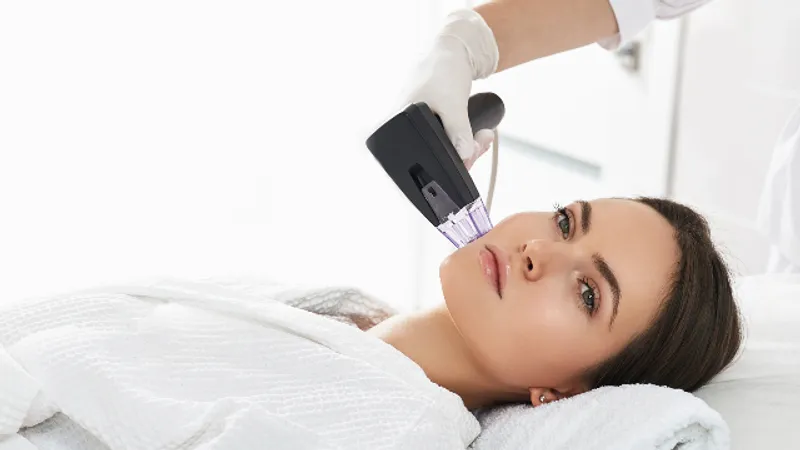
The clinic's described sequence is straightforward. The treatment area is cleansed. A thin layer of ultrasound gel is applied. The handpiece is placed against the skin and radiofrequency energy is delivered using the appropriate depth and energy settings, with cooling protecting the skin surface and improving comfort. The planned facial and neck areas are worked through, the gel is removed, and you can generally resume normal activities.
Duration depends on the area treated and the protocol used. A current registered clinical protocol used two treatment sessions approximately four weeks apart, with provision for up to three. That spacing is not arbitrary: the tissue response to heating develops over weeks, so sessions stacked too closely would be treating skin that has not yet shown what the previous session did.
Before treatment, arrive with the area clean, and tell the clinician about implanted electronic devices, metal implants, pregnancy or breastfeeding, active skin conditions, recent procedures, medications and relevant medical conditions. Aftercare is usually minimal — follow the clinic's instructions, avoid unnecessary irritation of the treated skin, and use appropriate sun protection.
That last item is more than routine advice. The American Academy of Dermatology's guidance on wrinkles emphasizes that ultraviolet exposure is a principal driver of the skin changes these treatments address, so sun protection is part of the treatment plan rather than an afterthought to it.
Who it suits, and who must avoid it
Adults with mild-to-moderate facial skin laxity, fine lines, early aging changes or loss of facial definition who want a non-invasive treatment are the intended candidates. Clinical research on the device has examined facial aging, lower-face and submental laxity, and eyebrow position.
The contraindications are firm and worth reading before you book, because several of them are absolute rather than relative:
- Implanted electronic devices such as pacemakers or defibrillators
- Active infection or inflammatory skin disease in the treatment area
- Pregnancy or breastfeeding
- Active malignancy in the treatment area
- Uncontrolled systemic disease
The pacemaker exclusion is the one people most often do not anticipate. A device that passes current through tissue is not compatible with an implanted device that senses electrical activity, and this is not a matter of caution that can be negotiated around.
Results, timing and honest expectations

Improvements develop progressively as thermal tissue effects and collagen remodeling occur. Studies of the device have assessed outcomes at one and three months after treatment, which gives a sense of the timescale on which this category is evaluated — not days.
Potential benefits include improvement in skin laxity, facial firmness, fine lines and facial contour, with research also examining eyebrow and upper-eyelid elevation and lower-face and neck tightening. Outcomes cannot be guaranteed, and the degree of change varies with skin condition, tissue characteristics and the starting degree of laxity.
Set expectations against the mechanism. A device working through the dermis is prompting a repair and remodeling response in tissue that is already there. Where the underlying problem is descent of deeper structures and genuine excess skin, the clinical literature on surgical facial rejuvenation describes an operation that repositions the deeper soft-tissue layer and removes redundancy — a different order of intervention. Choosing the non-invasive option when the anatomy calls for the surgical one produces a disappointing result through no fault of the device.
Side effects and recovery
Potential effects include temporary redness, swelling, warmth, tenderness or discomfort. The treatment is non-invasive with generally minimal downtime, and people in clinical protocols were able to leave after treatment.
The clinic's guidance for this treatment also identifies the risks specific to radiofrequency energy: excessive heating, burns, temporary sensory changes or uneven results, while noting these are not expected outcomes. Those are the failure modes to ask about, and they are a function of settings and technique rather than of the technology being inherently hazardous.
Where it fits in a consultation
XERF is one option among several the clinic offers for facial firmness, and the sensible conversation is not "should I have XERF" but "what is happening in my face, and which tool addresses it". The clinician evaluates skin laxity, facial anatomy, treatment goals, skin condition and medical history, then selects treatment areas and energy and depth settings accordingly.
The American Academy of Dermatology recommends establishing, before any cosmetic treatment, who will be performing it and what result is realistic in your case. The clinic's own overview gives the wider context. To ask which tool suits your face, use the consultation request page.
The Bottom Line
- XERF is a non-invasive monopolar radiofrequency treatment running two frequencies, 6.78 MHz and 2.0 MHz, with three-stage shallow, middle and deep depth control and cooling at the contact point.
- It generally does not require surgical anesthesia, which removes fasting, sedation recovery and escort requirements from the planning.
- Contraindications are firm: implanted electronic devices such as pacemakers, active infection or inflammatory skin disease in the area, pregnancy or breastfeeding, active malignancy in the area, and uncontrolled systemic disease.
- Change develops progressively over weeks; studies of the device have assessed outcomes at one and three months, and a registered protocol used two sessions about four weeks apart.
FAQ
Why does XERF use two frequencies instead of one?
Frequency substantially governs how deeply radiofrequency energy heats tissue, so a single-frequency system has one characteristic depth profile. Running 6.78 MHz and 2.0 MHz, with three-stage depth control layered on top, is how the device addresses more than one tissue depth in a session.
Does XERF require anesthesia?
Generally not. It is a non-surgical radiofrequency treatment and does not normally require surgical anesthesia; comfort during the session is managed by cooling at the contact point. The exact approach is confirmed during consultation.
How many sessions will I need?
A current registered clinical protocol used two treatment sessions approximately four weeks apart, with provision for up to three. The spacing reflects how long the tissue takes to show its response, and your own plan is set at consultation.
When will I see a change?
Progressively, as thermal tissue effects and collagen remodeling occur. Studies of the device have assessed outcomes at one and three months after treatment, which is the realistic timescale rather than days.
Who cannot have this treatment?
People with implanted electronic devices such as pacemakers or defibrillators, active infection or inflammatory skin disease in the treatment area, active malignancy in the treatment area, uncontrolled systemic disease, and people who are pregnant or breastfeeding.
What side effects should I expect?
Temporary redness, swelling, warmth, tenderness or discomfort are the common short-term effects. Excessive heating, burns, temporary sensory changes or uneven results are recognized risks of radiofrequency treatment, though they are not expected outcomes.
How does it compare with a surgical lift?
They operate at different scales. A surgical lift physically repositions and removes tissue and is the appropriate answer where laxity is substantial. XERF is a non-surgical tightening option suited to mild-to-moderate laxity, and choosing it for advanced laxity tends to disappoint.
This article is for general informational purposes and does not constitute individualized medical advice, and it is not a self-diagnosis tool. Care described here is delivered in the Republic of Korea under Korean medical licensure rather than United States licensure, and the clinic is closed on Sundays and observes a daily lunch break, which affects scheduling for short international trips. Speak with a qualified plastic surgeon about your own circumstances before making any treatment decision.
References
- American Academy of Dermatology: Wrinkle Treatment
- MedlinePlus: Skin Conditions
- StatPearls: Cervicofacial Rhytidectomy
- American Academy of Dermatology: Questions to Ask
- MedlinePlus: Plastic and Cosmetic Surgery
- American Academy of Dermatology: Cosmetic Treatment Safety