Personalized plastic surgery, laser & anti-aging care in Haeundae, Busan
en-US

EMFACE
EMFACE in Busan, Korea — synchronized RF and HIFES applied to forehead and cheeks in about 20 minutes, performed by Dr. Kim Ki-tae at TAE Plastic Surgery.

EMFACE in Busan, Korea

Medically reviewed by Dr. Kim Ki-tae, MD — Board-Certified Specialist in Plastic Surgery, Korean Society of Plastic and Reconstructive Surgeons; Director and founder, TAE Plastic Surgery Clinic TAE Plastic Surgery Clinic, Haeundae-gu, Busan
EMFACE in Busan is a non-invasive facial treatment that works on the facial muscles and the overlying skin at the same time. A session takes about 20 minutes, uses adhesive applicators on the forehead and cheeks, and is generally described as having little to no downtime. TAE Plastic Surgery Clinic in Haeundae-gu offers it as one of its non-surgical facial routes.
What Is EMFACE?
EMFACE is a non-invasive facial rejuvenation treatment designed to affect facial muscles and the overlying skin simultaneously, combining synchronized radiofrequency energy with HIFES technology.
HIFES stands for High-Intensity Facial Electrical Stimulation, and the branded system uses it together with synchronized RF.
Adhesive applicators deliver the energy to the treatment area.
Treatment is traditionally applied to the forehead and the cheeks.
During treatment the patient experiences warming together with rhythmic facial-muscle contractions.
It is generally delivered as a series rather than as a one-time treatment.
The potential benefits stated are improvement in facial-muscle tone and structure, facial firmness, selected aspects of the facial contour, skin laxity and wrinkles. On the wrinkle effect specifically, the clinic's own word is temporary: it describes temporary improvement of facial wrinkles through collagen induction and muscle stimulation, together with improvement of wrinkles and skin texture, skin regeneration and improved elasticity. That framing is worth keeping in mind when comparing offers elsewhere.
The comparison that matters most is with surgery. A facelift provides substantially greater tissue repositioning and removes excess tissue, and it is the more appropriate option where laxity is advanced. EMFACE does neither of those things, and patients with substantial skin or tissue laxity may obtain a more appropriate result from a surgical procedure. Reading those two sentences before booking saves a wasted trip.
Interest in this kind of treatment comes from patients who want a non-invasive option with little or no downtime, and from those looking for improvement in facial firmness, muscle tone, wrinkles or contour without undergoing surgery. Dr. Kim Ki-tae's published comment on the category is direct: "Lifting lasers that cause no pain, need no anaesthesia and let you return to daily life immediately after treatment are becoming popular."
Who Performs EMFACE at TAE Plastic Surgery Clinic

**Dr. Kim Ki-tae
**Board-Certified Plastic Surgeon
EMFACE is performed by Dr. Kim Ki-tae, the clinic's founder and sole doctor and the listed performing doctor for the parent Facial Lifting & Anti-Aging specialty.
Dr. Kim Ki-tae holds the Board-Certified Specialist designation in Plastic Surgery issued by the Korean Society of Plastic and Reconstructive Surgeons. He graduated from Inje University College of Medicine and trained as a Clinical Fellow in the Department of Plastic Surgery at Pusan National University from March 2003 to February 2004. He founded TAE Plastic Surgery Clinic in 2005 and has practised there ever since.
He chairs the Academic Committee of the Laser Plastic Surgery Research Group at the Korean Society of Plastic and Reconstructive Surgeons, sits on that society's Academic Committee, serves on the Legislation Committee of the Korean Association of Plastic Surgeons, and is General Affairs Director of the Busan Medical Association. He is a full member of the American Society for Laser Medicine and Surgery, an international member of the American Society of Plastic Surgeons, and a full member of the International Confederation for Plastic, Reconstructive and Aesthetic Surgery.
The clinic describes its own approach to this treatment in terms of one-to-one personalized care and customized planning, taking account of individual tissue characteristics, aesthetic goals and recovery needs. TAE Plastic Surgery Clinic is a single-doctor clinic, so the surgeon who assesses you is the surgeon who treats you. His profile is on the doctor page, and EMFACE sits within the clinic's Facial Lifting & Anti-Aging specialty.
Who Is a Good Candidate for EMFACE?
This treatment is aimed at facial muscle and overlying skin at the same time, and it is delivered as a course, so both of those shape who it suits.
You may be a candidate if
Your concern is wrinkles and sagging that follow declining skin elasticity, which is how the clinic describes the patient it treats with this.
What you want changed is in the mid-face and forehead, the areas the clinic identifies as of current interest and the areas the applicators are placed on.
You want the underlying facial-muscle characteristics addressed as well as the skin, without surgery.
Your facial laxity is mild to moderate, with early aging signs, fine lines or a loss of facial definition alongside it.
You can attend a course rather than a single appointment, since the commonly studied protocol is four treatments about a week apart.
You want a treatment with little or no downtime and no incision.
You should not proceed, or should be assessed first, if
You are pregnant or breastfeeding.
You have a pacemaker or defibrillator.
You have relevant metal implants.
You have an active skin infection or significant skin disease in the treatment area.
You have a medical condition affecting muscles or nerves.
You have substantial skin or tissue laxity, in which case surgical procedures may give a more appropriate result.
What to Expect: Procedure, Recovery, and Results Timeline

Before the applicators go on, the clinician assesses skin condition, facial structure, degree of laxity, muscle characteristics, treatment goals and medical history, and reviews any contraindications. Arrive with the treatment area clean and free of cosmetics and lotions, and remove jewelry or other objects that could interfere. Anesthesia is generally not required, because the treatment is non-invasive.
The session itself follows a set sequence:
Clean the treatment area and remove cosmetics, lotions and relevant jewelry.
Position the applicators on the designated facial areas, traditionally the forehead and cheeks.
Begin synchronized RF and HIFES stimulation at a tolerable intensity.
Warming and rhythmic facial-muscle contractions are felt during the treatment.
After approximately 20 minutes, the applicators are removed and the skin is cleaned.
Normal activities can generally be resumed.
| Item | What the clinic and the study protocols state |
|---|---|
| Session length | Approximately 20 minutes, though timing can vary by treatment plan |
| Course | A commonly studied protocol is four treatments, usually about 5 to 10 days or one week apart |
| Downtime | Little to none; clinical studies discharged patients immediately after treatment |
| Early recovery | Any redness generally settles within a few hours to a day |
| Results | Improvement may develop progressively after the course, with studies assessing outcomes at one and three months |
| Best assessment point | Some clinical reports place optimal results around 8 to 12 weeks after the final session |
| Travel | An extended medical stay is generally not required, and most patients fly home the same day or the next |
Aftercare is usually minimal. Patients can generally return to ordinary activities immediately, and gentle skincare and sun protection are reasonable general measures. Avoid sun exposure, tanning and strong retinoid or exfoliating products in the days before treatment, and follow any restriction the treating provider specifies afterward. Typical practice is a follow-up check after the final session in a course, with further visits if another course is recommended.
The clinic has not published a price or a price range for this procedure, so none is stated here, and cost is confirmed at consultation.
Combining EMFACE with Other Treatments
The clinic states that EMFACE may be incorporated into broader non-surgical rejuvenation plans, and that it can potentially be combined with injectables, lasers or other skin treatments, with timing and compatibility determined individually. Related pages in this batch:
Skin Tightening — the clinic's ONDA, Fascella, DoubleTite and HALO group.
XERF — its other single-device non-invasive option.
NP Profound — needle-delivered RF, for laxity that needs deeper treatment.
Botox with TargetCool — relevant because Botox and EMFACE act on facial muscles in opposite directions.
Facial Lifting & Anti-Aging — the parent specialty page.
Safety, Precision, and Clinic Standards
TAE Plastic Surgery Clinic is a Registered Medical Institution for Attracting Foreign Patients, certified by the Ministry of Health and Welfare under the Medical Overseas Expansion and Foreign Patients Attraction Act. TAE Plastic Surgery Clinic publishes neither case volumes nor complication rates for this procedure, and this page claims neither. The clinic has not published an approved-claims list for this procedure and this market, so this page states no efficacy or outcome claim beyond what the clinic itself documents.
The reported and possible effects are temporary redness, mild swelling, warmth, dry skin, muscular discomfort or soreness, temporary muscle spasms and headache. Rare heat-related skin injury such as blistering or burns is described in patient-consent materials. Possible risks depend on individual health and on the device's contraindications, which is why the screening described above happens before the applicators are positioned rather than afterward.
The clinic states that it holds a wide range of premium laser and energy-based devices beyond the level of a general dermatology practice. Applied to EMFACE, that means the treatment is considered alongside the clinic's other surgical and device options rather than in isolation. The clinic reports approximately 240 surgical procedures and approximately 3,600 non-surgical treatments a year; these are clinic-wide totals across everything it offers, not figures for this procedure.
For independent background, the American Academy of Dermatology publishes patient information on cosmetic skin treatments (AAD), and the American Society of Plastic Surgeons publishes procedure information covering both surgical and non-surgical options (ASPS).
The Bottom Line
EMFACE combines synchronized RF with HIFES and is applied through adhesive applicators, traditionally to the forehead and cheeks.
A session is about 20 minutes, and a commonly studied course is four treatments roughly a week apart.
Downtime is little to none, and normal activities can generally be resumed straight away.
The clinic's own word for the wrinkle benefit is temporary, and results build over the weeks after the course.
Pacemakers, defibrillators, relevant metal implants and pregnancy are screened for before treatment.
FAQ
Who is EMFACE for?
Patients concerned with wrinkles and sagging caused by declining skin elasticity, and those seeking care of the mid-face and forehead, which the clinic identifies as areas of current interest. Adults with mild-to-moderate laxity and early aging changes are the usual candidates. Substantial laxity is generally better addressed surgically.
Does it hurt, and is anesthesia used?
EMFACE is generally described as non-invasive, with muscle contractions and warming sensations rather than surgical pain. Anesthesia is generally not required for this reason. Intensity is set at a level you can tolerate.
How many sessions are needed, and how long is each one?
A session commonly takes around 20 minutes, although timing can vary with the treatment plan. A commonly studied protocol consists of four treatments, usually spaced about 5 to 10 days or one week apart. Your own schedule is set at consultation.
How is EMFACE different from Botox or from RF tightening?
Botox chemically reduces targeted muscle activity, while EMFACE electrically stimulates facial muscles — the two act in opposite directions. Conventional RF tightening primarily targets tissue heating and remodeling, whereas EMFACE combines RF with muscle stimulation. Ultrasound-based treatments target deeper tissue layers instead.
When will I see the result?
Improvements may develop progressively after the treatment course rather than immediately. Studies have assessed outcomes at one and three months, and some clinical reports place optimal results around 8 to 12 weeks after the final session. A subtle change can appear within a few sessions and build across the course.
What side effects should I expect?
Temporary redness, warmth, tingling, or muscle soreness and fatigue can occur. Mild swelling, dry skin, temporary muscle spasms and headache have also been reported. Rare heat-related skin injury such as blistering or burns is described in patient-consent materials.
I am travelling from overseas — how should I plan the trip?
Plan around the course, not around recovery. No extended medical stay is usually required for a non-invasive treatment, and clinical studies discharged patients immediately after treatment, so the constraint is the schedule rather than downtime. A commonly studied protocol is four sessions spaced about five to ten days apart, which one short trip will not cover, and the timing of any long-haul flight after a session is confirmed with the treating doctor.
Book a Consultation at TAE Plastic Surgery Clinic
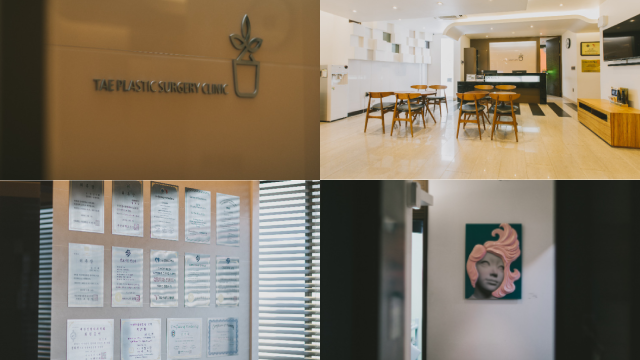
EMFACE is offered in Busan at TAE Plastic Surgery Clinic, and the consultation covers contraindication screening as well as whether this treatment matches what you want changed. English-speaking assistance is available for both online and in-person consultations, and consultations are arranged through the clinic's contact page. TAE Plastic Surgery Clinic is at 4th Floor, Gunam Building, 27 Gunam-ro, Haeundae-gu, Busan, South Korea, and opens Monday to Friday from 09:00 to 18:00 and Saturday from 09:00 to 13:00, closed Sundays and public holidays.
Disclaimer
This page is for general informational purposes and does not constitute individualized medical advice. Candidacy, technique, anaesthesia and outcome can only be determined in an in-person consultation with a qualified doctor. Individual results vary.
References
American Academy of Dermatology — Cosmetic treatments
American Society of Plastic Surgeons — Cosmetic procedures