Personalized plastic surgery, laser & anti-aging care in Haeundae, Busan
en-US

Under-Eye Fat Correction
Under-eye fat correction removes protruding fat and grafts fat back, through an inner-eyelid incision. Dr. Kim Ki-tae, TAE Plastic Surgery, Busan.

Under-Eye Fat Correction in Busan, Korea

Medically reviewed by Dr. Kim Ki-tae, MD — Board-Certified Specialist in Plastic Surgery, Korean Society of Plastic and Reconstructive Surgeons; Director and founder, TAE Plastic Surgery Clinic TAE Plastic Surgery Clinic, Haeundae-gu, Busan
Under-eye fat correction in Busan is the surgical treatment TAE Plastic Surgery Clinic uses to remove under-eye fat and dark circles without worrying about scars, using a conjunctival incision. It is performed at the clinic's Haeundae-gu premises by Dr. Kim Ki-tae. The defining feature is that fat is removed and fat is grafted in the same operation, rather than existing fat being slid downward into the hollow beneath it.
American patients most often reach this page after trying something else. Filler is the usual first attempt, and it frequently disappoints when the under-eye is bulging and hollow at the same time, because adding volume to a hollow does nothing about the bulge in front of it. Others arrive already quoted for lower blepharoplasty at home and are specifically looking for an approach that does not cut the skin outside the eye.
There is a practical reason the under-eye comes up so often with US patients in particular. Dark circles and under-eye bags read as chronic tiredness in professional and video-call settings, and they are one of the most common triggers for a first aesthetic consultation. A second recurring question is ectropion — the lower lid turning outward — which the clinic's own material names when it describes the external-incision alternative. A third is scheduling: this is a single surgical visit that can be combined with other facial work, which suits patients travelling from North America for a limited number of days.
What Is Under-Eye Fat Correction?
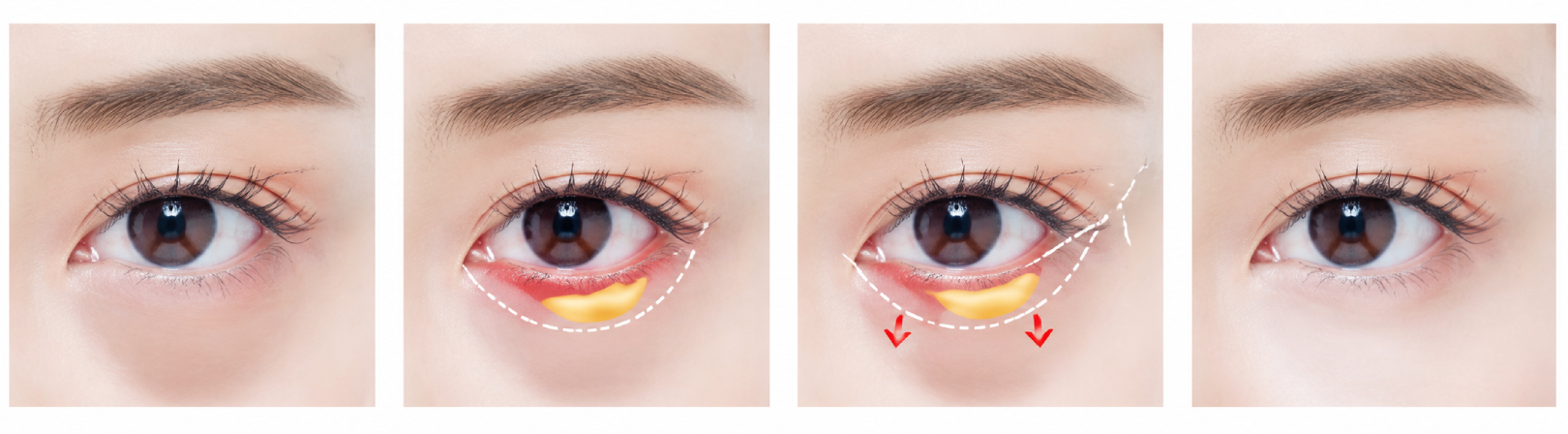
Under-eye fat correction removes the protruding fat and then grafts fat harvested from another area back into the under-eye region, so that removal and grafting are performed together.
The incision is made on the inner conjunctival surface of the eyelid, which the clinic describes as carrying comparatively less burden of a scar visible on the skin surface.
The protruding orbital fat is removed rather than repositioned.
Fat for the graft is harvested from a donor area on the same patient during the same operation.
For the graft, fat cells from the superficial layer close to the skin surface are finely processed before transfer, which the clinic states can help produce a comparatively natural contour even in a thin-skinned area such as the under-eye.
The clinic describes the technique as a skin-incision-free approach designed to reduce scarring and recovery time.
Dr. Kim Ki-tae has published the distinction between this operation and the similarly named alternative:
"Under-eye fat repositioning and under-eye fat correction have similar names, but they differ in surgical approach and in process. Because every patient's anatomical structure and under-eye condition is different, it is important to set an appropriate surgical plan through sufficient consultation and diagnosis."
The American Society of Plastic Surgeons publishes general background on lower eyelid procedures for patients researching the category (ASPS).
Who Performs Under-Eye Fat Correction at TAE Plastic Surgery Clinic

**Dr. Kim Ki-tae
**Board-Certified Plastic Surgeon
Under-Eye Fat Correction is performed by Dr. Kim Ki-tae, the clinic's founder and sole doctor and the listed performing doctor for the parent Eye Plastic Surgery specialty.
Dr. Kim Ki-tae holds the Board-Certified Specialist designation in Plastic Surgery issued by the Korean Society of Plastic and Reconstructive Surgeons. He graduated from Inje University College of Medicine and trained as a Clinical Fellow in the Department of Plastic Surgery at Pusan National University from March 2003 to February 2004. He founded TAE Plastic Surgery Clinic in 2005 and has practised there ever since.
The specific technique behind this page appears by name in the clinic's own materials: transconjunctival under-eye surgery combining fat removal with grafting of finely processed superficial-layer fat cells. The stated patient benefit is correction of combined bulging and hollowing with less burden of a visible surface scar. TAE Plastic Surgery Clinic is a single-doctor clinic, so the surgeon who assesses you is the surgeon who treats you. Further background is on the doctor profile page.
Under-Eye Fat Correction Options and Types Available
The clinic's material sets this operation against the repositioning approach it is most often confused with. The two are described as differing in surgical route and in what happens to the fat.
| Under-eye fat correction as performed here | Under-eye fat repositioning, external-incision form | |
|---|---|---|
| Route | Incision on the inner conjunctival surface of the eyelid | Incision in the skin outside the eye |
| What happens to the protruding fat | Removed | Pulled into the hollow area and fixed there |
| Volume restoration | Separately harvested fat, finely processed, grafted into the under-eye | None; the existing fat is redistributed |
| Scarring | Described by the clinic as carrying comparatively less burden of a surface scar | The clinic's material states this form may carry a burden regarding scarring |
| Points the clinic flags for consideration | — | Possibility of ectropion, the eyelid turning outward, during the process of pulling and fixing the fat; possibility of fat protruding again over time |
Which approach suits a given under-eye is decided at assessment, not in advance.
Who Is a Good Candidate for Under-Eye Fat Correction?
Generally suitable:
Patients whose under-eye shows orbital fat protruding forward.
Patients with the combined pattern in which the area looks bulging and hollow at the same time.
Patients whose eye shape, fat volume and skin thickness have been assessed together.
Patients whose dark under-eye appearance comes from contour and shadow rather than from pigmentation alone.
Generally not suitable, or requiring review before proceeding:
Patients who are pregnant or breastfeeding.
Patients with uncontrolled medical conditions that may affect surgery or healing.
Patients with an active infection around the treatment area.
Patients with active eye infections or severe dry eye syndrome.
Patients with uncontrolled glaucoma.
Patients with bleeding disorders or unmanaged systemic conditions.
Patients with unrealistic expectations about the outcome.
The clinic states that a diagnosis considering eye shape, the amount of fat and skin thickness is required because the periorbital area has thin skin and a dense concentration of blood vessels and nerves. A final decision is made by the doctor after assessing the patient's individual health, medical history, and treatment goals.
What to Expect: Procedure, Recovery, and Results Timeline
The assessment begins by establishing whether the under-eye change is caused by fat protrusion, loss of skin elasticity, volume loss, or a combination. The clinic states that a structural cause must be identified accurately before a method is chosen. International patients from the United States would normally submit photographs for a pre-travel review.
The operation itself runs in this order:
Assessment of the under-eye structure and the balance between protrusion and hollowing.
Planning of how much fat to remove and how much to graft back.
Administration of anesthesia.
Incision made on the inner conjunctival surface of the eyelid.
Removal of the protruding orbital fat.
Harvest of fat from a donor area and fine processing of superficial-layer fat cells.
Grafting of the processed fat into the under-eye to restore volume.
Recovery-room observation and discharge instructions.
Anesthesia for this procedure is typically local anesthesia with sedation, or general anesthesia depending on the extent of surgery. The clinic states that pain during the procedure is minimal. Mild tightness or pressure may be felt for one to three days afterwards.
Preparation includes stopping blood-thinning medication and supplements one to two weeks beforehand. Smoking and alcohol are avoided in the same window. Fasting is required before anesthesia. Routine pre-operative blood tests are completed beforehand. Patients with chronic conditions or regular medication should raise these at consultation so the plan can be adjusted individually.
| Point in recovery | What the clinic documents |
|---|---|
| First 48 hours | Acute swelling peaks |
| Day 5–7 | Flying home is generally cleared after early recovery checks |
| Day 7–10 | Minor bruising subsides |
| Week 1–2 | Normal non-strenuous daily activity resumes; initial smoothing of under-eye bags becomes noticeable |
| Week 2–3 | Visible change is usually apparent as most swelling resolves |
| Around 3 months | The fully settled result is typically seen |
| 3–6 months | Complete tissue settling and natural contour integration over the tear trough |
Aftercare involves keeping the area clean and protected as advised. Strenuous exercise, heavy lifting, alcohol and smoking are avoided for two to four weeks. Rubbing the eyes, contact lenses, eye makeup, stooping down and sauna use are avoided for two to three weeks. Written aftercare guidance is provided to every patient and covers the specific day-by-day timeline.
The procedure itself typically takes one to three hours, depending on complexity. International patients are generally advised to plan roughly one to two weeks in Korea. Typical practice is one in-person follow-up before departing Korea, with further check-ins available remotely.
Combining Under-Eye Fat Correction with Other Treatments
Combination is common where more than one structure is contributing to the tired appearance, and the right pairing depends on the patient's specific anatomy and goals.
Fat Grafting & Anti-Aging — where midface volume loss is contributing alongside the under-eye itself.
Autologous Fat Grafting for Aegyo-Sal — where the patient also wants definition in the roll directly beneath the lash line.
Bespoke Eye Surgery — where an upper-eyelid concern is being addressed in the same plan.
HALO Laser — facial laser skin resurfacing of the surrounding area.
The decision is made together with the treating doctor at consultation rather than assembled from a list in advance.
Safety, Precision, and Clinic Standards
TAE Plastic Surgery Clinic is a Registered Medical Institution for Attracting Foreign Patients, certified by the Ministry of Health and Welfare under the Medical Overseas Expansion and Foreign Patients Attraction Act. The clinic states that risk here is reduced by using transconjunctival micro-incisions inside the eyelid. It states that the integrity of the orbital septum is preserved. It states that precise electrocautery is used.
The documented risks are as follows. Temporary swelling and bruising are expected. Discomfort is common. Bleeding or infection can occur. Asymmetry is possible. Contour irregularities are possible. Residual or recurrent fat bulging or hollowing can occur. Over-correction or under-correction is possible. Sensory changes can occur. Minor subconjunctival hemorrhage is a recognized effect. Rarely, eyelid malposition, persistent dry eye, visual disturbance, or injury to surrounding orbital structures can occur.
Completely eliminating dark circles caused purely by skin pigmentation or thin vascular skin is outside what this operation addresses. The clinic has not published an approved-claims list for this procedure and this market, so this page states no efficacy or outcome claim beyond what the clinic itself documents. TAE Plastic Surgery Clinic publishes neither case volumes nor complication rates for this procedure, and this page claims neither. The clinic has not published a price or a price range for this procedure, so none is stated here, and cost is confirmed at consultation. Independent risk information on eyelid surgery is published by the NHS (NHS).
The Bottom Line
Removal and grafting happen in one operation, which is what separates this from repositioning existing fat.
The route is transconjunctival, so there is no incision on the skin outside the eye.
The graft uses finely processed superficial-layer fat cells, chosen because the periorbital skin is thin.
Candidacy turns on whether the under-eye problem is contour or pigmentation.
Most swelling resolves in two to three weeks, and the settled result is typically seen at around three months.
FAQ
How is this different from under-eye fat repositioning? Repositioning slides the existing protruding fat down into the hollow and fixes it there. This operation removes that fat and grafts separately harvested fat into the hollow instead. Dr. Kim Ki-tae states the two differ in surgical approach and in process despite the similar names.
Will there be a visible scar? The incision is placed on the inner conjunctival surface of the eyelid, so there is no cut on the skin outside the eye. The clinic describes this as carrying comparatively less burden of a scar visible on the skin surface. It is one of the reasons patients choose this route over the external-incision alternative.
How long does the operation take? Typically 30 minutes to one hour for the under-eye work itself, with the total theater time running to between one and three hours depending on complexity. The variation depends on how much is being done in the same session. Your expected duration is confirmed at consultation.
Will this fix my dark circles? It addresses dark circles that come from contour and shadow, because removing the bulge and filling the hollow changes how light falls on the area. Dark circles caused purely by skin pigmentation or thin vascular skin are a different problem and are not corrected by this operation. Which type you have is established at assessment.
How long do I need to stay in Korea? A stay of five to seven days is recommended so that post-operative progress checks can be completed and the initial swelling and bruising can subside. Patients can generally board flights five to seven days after the procedure. Two follow-up visits are typical: an immediate swelling check and a final pre-departure evaluation.
What should I avoid afterwards? Avoid rubbing the eyes, contact lenses and eye makeup for two to three weeks. Avoid heavy lifting, stooping down and sauna use over the same period. Strenuous exercise, alcohol and smoking are avoided for two to four weeks.
Why not just have filler again? Dermal filler adds temporary volume to the tear trough and has to be repeated as it breaks down. This operation reshapes the tissue itself, removing the protruding fat and grafting the patient's own fat into the hollow. The clinic's material presents the two as different in kind rather than in degree, and filler remains a reasonable option where the concern is volume alone.
What photographs does the clinic need? High-resolution frontal and 45-degree angle eye photographs, taken looking straight ahead, upward, and downward. Relevant eye medical history should be sent with them. Online consultation is available on this basis.
Book a Consultation at TAE Plastic Surgery Clinic

Under-eye fat correction is performed in Busan, at the clinic's Haeundae-gu premises, by Dr. Kim Ki-tae. English-speaking assistance is available for both online and in-person consultations, and consultations are arranged through the clinic's contact page. TAE Plastic Surgery Clinic is at 4th Floor, Gunam Building, 27 Gunam-ro, Haeundae-gu, Busan, South Korea, and opens Monday to Friday from 09:00 to 18:00 and Saturday from 09:00 to 13:00, closed Sundays and public holidays.
Sending the photographs listed above with a first enquiry lets the pre-travel review start before flights are booked.
Disclaimer
This page is for general informational purposes and does not constitute individualized medical advice. Candidacy, technique, anaesthesia and outcome can only be determined in an in-person consultation with a qualified doctor. Individual results vary.
References
American Society of Plastic Surgeons — Eyelid Surgery: