Personalized plastic surgery, laser & anti-aging care in Haeundae, Busan
en-US

Revision Eye Surgery
Revision eye surgery corrects an unsatisfactory result from previous eyelid surgery, cause by cause. Dr. Kim Ki-tae, TAE Plastic Surgery, Busan, Korea.

Revision Eye Surgery in Busan, Korea

Medically reviewed by Dr. Kim Ki-tae, MD — Board-Certified Specialist in Plastic Surgery, Korean Society of Plastic and Reconstructive Surgeons; Director and founder, TAE Plastic Surgery Clinic TAE Plastic Surgery Clinic, Haeundae-gu, Busan
Revision eye surgery in Busan, at TAE Plastic Surgery Clinic, is a corrective eyelid procedure performed after previous eye surgery when the patient has an unsatisfactory aesthetic or functional result. It is assessed and carried out at the clinic's Haeundae-gu premises. It may address an overly thick or high crease, asymmetric eyelids, a faint or loosened crease, a visible surgical appearance or scarring, or other problems caused by the first operation.
Revision is a strong reason American patients travel. Someone unhappy after eyelid surgery at home often cannot go back to the original surgeon, and the question then becomes who is willing to work on tissue that has already been operated on. This page describes how that assessment is structured here, and it is candid about what the second operation can and cannot recover.
What Is Revision Eye Surgery?
Revision eye surgery is a second eyelid operation performed to correct a specific, identified problem left by an earlier one.
The starting point is the cause of the unsatisfactory result, not the appearance on its own.
The clinic describes revision as a cause-based procedure, analyzing crease height, eye shape, eyelid and muscle condition and fat volume before choosing the technique.
Revision is technically more challenging than primary surgery, because previous surgery changes normal anatomy and creates scar tissue.
The available skin, fat, muscle and scar tissue may differ substantially from the original anatomy, so each case is planned individually.
The realistic aim is improvement of the previous result within the limits set by existing scar tissue and altered anatomy, not restoration of the original eye.
Typical concerns behind these consultations include asymmetry, overly high or unnatural folds, recurrence or loosening of the crease, scarring, a puffy appearance sometimes described as a "sausage" eyelid, and functional problems such as incomplete eyelid closure or residual ptosis. General background on eyelid surgery, including the possibility that further surgery is needed, is published by the American Society of Plastic Surgeons (ASPS).
Who Performs Revision Eye Surgery at TAE Plastic Surgery Clinic
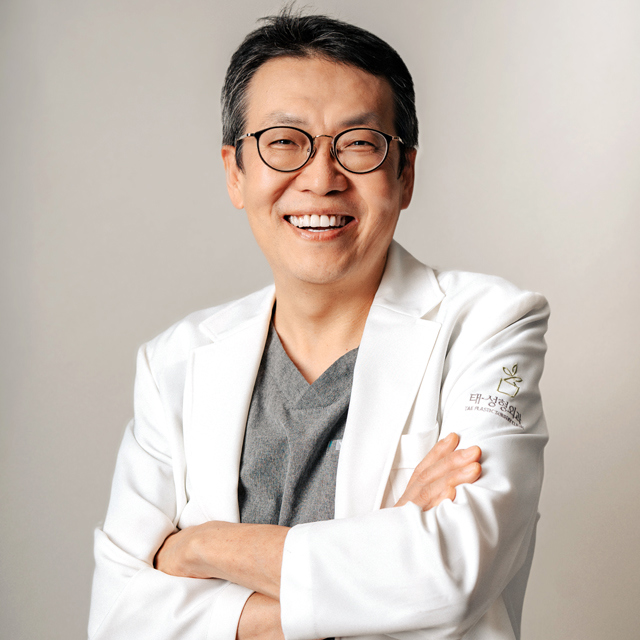
**Dr. Kim Ki-tae
**Board-Certified Plastic Surgeon
Revision Eye Surgery is performed by Dr. Kim Ki-tae, the clinic's founder and sole doctor and the listed performing doctor for the parent Eye Plastic Surgery specialty.
Dr. Kim Ki-tae holds the Board-Certified Specialist designation in Plastic Surgery issued by the Korean Society of Plastic and Reconstructive Surgeons. He graduated from Inje University College of Medicine and trained as a Clinical Fellow in the Department of Plastic Surgery at Pusan National University from March 2003 to February 2004. He founded TAE Plastic Surgery Clinic in 2005 and has practised there ever since.
He chairs the Academic Committee of the Laser Plastic Surgery Research Group at the Korean Society of Plastic and Reconstructive Surgeons, sits on that society's Academic Committee, serves on the Legislation Committee of the Korean Association of Plastic Surgeons, and is General Affairs Director of the Busan Medical Association. He is a full member of the American Society for Laser Medicine and Surgery, an international member of the American Society of Plastic Surgeons, and a full member of the International Confederation for Plastic, Reconstructive and Aesthetic Surgery. The clinic states he is known as a doctor who teaches doctors, lecturing and running live procedure training in Korea and abroad.
For a revision case, continuity is not a small detail. TAE Plastic Surgery Clinic is a single-doctor clinic, so the surgeon who assesses you is the surgeon who treats you. The clinic's stated approach to revision begins with identifying the cause of the previous failure, and it emphasizes minimizing additional damage to tissue already affected by earlier surgery. Full credentials are listed on the doctor profile page.
Revision Eye Surgery Options and Types Available
The technique follows the finding. The clinic's documented framework pairs each identified cause with a corresponding approach.
| Identified problem | Documented approach |
|---|---|
| Thick or puffy "sausage" eyelids | Unnecessary tissue or fat may be removed and the crease redesigned |
| Asymmetry between the two eyes | The existing line may be released and redesigned |
| A weak or faded crease | Natural-adhesion or incisional revision may be used |
| An overly obvious surgical appearance | The line can be made shallower and scars addressed |
Not every dissatisfying result needs another operation. Depending on the problem, the alternatives include simply observing while swelling settles, non-surgical scar management where appropriate, primary or revision double-eyelid correction, ptosis correction, upper blepharoplasty, lower blepharoplasty, or fat repositioning. Which of these applies is the substance of the consultation.
Who Is a Good Candidate for Revision Eye Surgery?
Generally suitable:
Patients with stable, persistent problems after previous eyelid surgery.
Patients whose tissues have sufficiently healed for meaningful assessment.
Patients with asymmetric creases.
Patients with an excessively high or thick crease.
Patients with a loosened or faint crease.
Patients with visible scarring from the earlier operation.
Patients with persistent puffiness.
Patients with residual eyelid-opening or ptosis problems.
Generally not suitable, or requiring review before proceeding:
Patients whose postoperative tissues have not adequately healed.
Patients whose expectations are unrealistic for their remaining tissue.
Patients whose underlying problem can be managed without another operation.
Patients with active infection or inflammation.
Patients with a medical condition that could interfere with healing.
Acute postoperative swelling makes early assessment unreliable. Several Korean clinics recommend waiting around six months before routine revision, although selected complications may require earlier assessment or intervention. Revision surgery requires careful evaluation precisely because the tissue has already been operated on.
What to Expect: Procedure, Recovery, and Results Timeline

The surgeon reviews the previous surgery and assesses the current crease height and shape, symmetry, eyelid and muscle condition, scar tissue and adhesions, skin availability, and fat volume. The clinic states that its analysis considers the existing double-eyelid height and eye shape, eyelid and muscle condition, and amount of fat before selecting the revision method.
The operation generally runs in this order, although the exact steps vary considerably with the original surgery and the revision problem:
Review the previous operation and the current concerns.
Identify the cause of the unsatisfactory result.
Design the new crease or eyelid contour according to the anatomy.
Release or revise previous adhesions and scar tissue where necessary.
Remove, reposition or preserve tissue according to the problem.
Re-establish the eyelid crease, or correct eyelid-opening function where indicated.
Close the incision and provide postoperative instructions.
The clinic has not published an anaesthesia or pain-control protocol for this procedure, so none is described here; it is confirmed with the medical team before treatment.
Many straightforward revision eyelid procedures take about one hour, while more complex scar-release or reconstruction cases take longer. Published Korean clinic examples report approximately 60 to 90 minutes. Sutures, when used, are commonly removed roughly five to seven days after surgery, although timing varies by technique.
| Point in recovery | What is documented |
|---|---|
| First several days to weeks | Initial swelling and bruising generally improve |
| Around 5–7 days | Some Korean clinics quote this as a basic return to daily activities; sutures commonly removed |
| 1–2 weeks | Bruising typically resolves; an early postoperative assessment is often scheduled |
| 7–10 days | Most patients can fly home once the surgeon has cleared them at a follow-up check |
| 10–21 days | One revision-eye clinic reports this range before patients look presentable |
| Several months | Swelling and scar maturation continue |
| 6–12 months | Final results, as reported by that same revision-eye clinic |
International patients are generally advised to plan roughly one to two weeks in Korea. Revision cases may remain visibly swollen longer than primary surgery, and recovery is less predictable because previously operated tissue is involved. The visible result develops progressively as swelling resolves and scars mature, so the early postoperative appearance should not be treated as the final one.
Before surgery, give the surgeon details of previous eyelid operations, including approximate dates and techniques if you know them, and bring previous operative records and photographs where available. Discuss medications, medical conditions and previous complications. Aspirin, some anti-inflammatory medicines and certain herbal supplements can increase bleeding and bruising risk, and smoking should be discussed because it can affect healing. Do not stop prescribed medication without medical advice. Do not make a revision decision solely on the basis of early postoperative swelling.
Afterwards, follow the surgeon's wound-care and medication instructions, protect the surgical area, avoid rubbing or trauma, and attend the scheduled postoperative checks. Strenuous activity, heavy lifting and bending may need to be restricted during early recovery. Longevity of the corrected result depends on the underlying anatomy, the surgical technique, aging, and whether the original problem recurs.
Combining Revision Eye Surgery with Other Treatments
Depending on anatomy, revision may be combined with other eyelid work. Combination surgery should be based on the underlying cause rather than performed simply to add procedures.
Under-Eye Fat Correction — where lower-lid fat is part of the problem being corrected.
Autologous Fat Grafting for Aegyo-Sal — where volume beneath the lash line needs rebuilding as part of the plan.
Bespoke Eye Surgery — where ptosis correction or blepharoplasty belongs in the same individualized plan.
Scar Treatment — where scar and adhesion management is a distinct part of the problem.
Safety, Precision, and Clinic Standards
TAE Plastic Surgery Clinic is a Registered Medical Institution for Attracting Foreign Patients, certified by the Ministry of Health and Welfare under the Medical Overseas Expansion and Foreign Patients Attraction Act. Revision work here starts from a diagnosis rather than from a technique. The clinic states that its revision approach begins with identifying the cause of the previous failure. It states that it evaluates crease height, eye shape, eyelid and muscle condition and fat volume. It states that it emphasizes minimizing additional damage to tissue already affected by previous surgery.
The documented risks are as follows. Asymmetry can persist. The crease can recur or loosen again. Scarring can be visible or excessive. Contour irregularity can occur. Puffiness can occur. Correction can be insufficient or excessive. Eyelid sensation can be altered. Dry-eye symptoms can occur. Difficulty closing the eyes is a recognized complication. Eyelid malposition and ptosis problems are recognized complications. Bleeding and infection are possible. Poor healing is possible. Vision changes are possible. Further surgery may be needed.
An exact crease height cannot be promised. Perfect symmetry cannot be promised. The exact pre-surgery appearance cannot be restored. Results depend heavily on scar tissue, remaining skin and tissue quality, and the cause of the original problem. TAE Plastic Surgery Clinic publishes neither case volumes nor complication rates for this procedure, and this page claims neither. The clinic has not published a price or a price range for this procedure, so none is stated here, and cost is confirmed at consultation. Independent patient-facing information on eyelid surgery and its risks is published by the NHS (NHS) and on cosmetic treatment decisions by the American Academy of Dermatology (AAD).
The Bottom Line
Revision here is cause-based: crease height, eye shape, eyelid and muscle condition and fat volume are analyzed before a technique is chosen.
Four documented problem patterns each have a corresponding approach, from redesigning the crease to making an obvious line shallower.
Waiting around six months after the first operation is the general recommendation, because early swelling makes assessment unreliable.
Recovery is slower and less predictable than after primary surgery, with final results reported at six to twelve months.
The goal is improvement within the limits of existing scar tissue, not a return to the original eye.
FAQ
How long after my first surgery can I have a revision? Several Korean clinics recommend waiting around six months before routine revision. The reason is that acute postoperative swelling makes assessment unreliable, and a decision taken during that period may be based on an appearance that would have changed anyway. Selected complications may require earlier assessment or intervention, so contact a surgeon promptly if something is wrong rather than waiting out the six months.
Can a surgeon in Korea correct eyelid surgery performed in the United States? Revision is planned from the current anatomy rather than from the original operation, so where the first surgery took place does not by itself prevent correction. The surgeon reviews the previous surgery, the current crease, symmetry, muscle condition, scar tissue and available skin. Bring your previous operative records and photographs if you have them, because they shorten that process.
Why is revision harder than the original operation? Previous surgery changes normal anatomy and creates scar tissue. The skin, fat, muscle and scar available to work with may differ substantially from what was there the first time. That is also why recovery is less predictable and why the result is constrained by what remains.
What can I realistically expect? Improvement of the previous result within the limits set by existing scar tissue and altered anatomy. That can mean a more balanced crease, better symmetry, correction of a crease that is too high, too thick or too loose, a reduction in the obviously operated appearance, and in appropriately selected cases improvement of eyelid-opening problems. It does not mean the eye you had before the first surgery.
How long should I plan to be in Korea? Roughly one to two weeks. Most patients can fly home once initial swelling and bruising have begun to settle and the surgeon has cleared them at a follow-up check, typically after a week to ten days. Revision eyelid surgery may require an early postoperative assessment within one to two weeks.
When will I look presentable? Bruising may last around one to two weeks. One revision-eye clinic reports ten to twenty-one days before patients look presentable, which is longer than most people expect. Swelling and scar maturation then continue for several months, with final results reported at approximately six to twelve months.
What should I send or bring to the consultation? Clear front, side and oblique eye photographs, with the eyes open and closed, plus any pre-surgery photographs you still have. Include previous surgical records and information about the earlier procedures or complications. The surgeon needs to understand what was done before and what you want changed.
Is another operation always the answer? No. Depending on the problem, the appropriate course may be observation while swelling settles, or non-surgical scar management. Where surgery is indicated, the options range from crease revision to ptosis correction, blepharoplasty or fat repositioning. The point of the assessment is to establish which of those the finding actually calls for.
Book a Consultation at TAE Plastic Surgery Clinic
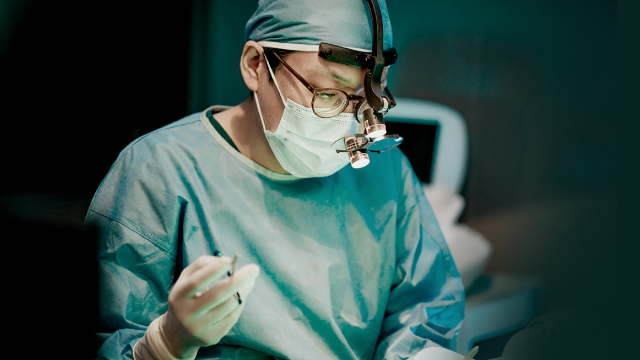
Revision eye surgery is assessed and performed in Busan by Dr. Kim Ki-tae at the clinic's Haeundae-gu premises. English-speaking assistance is available for both online and in-person consultations, and consultations are arranged through the clinic's contact page. TAE Plastic Surgery Clinic is at 4th Floor, Gunam Building, 27 Gunam-ro, Haeundae-gu, Busan, South Korea, and opens Monday to Friday from 09:00 to 18:00 and Saturday from 09:00 to 13:00, closed Sundays and public holidays.
If you are enquiring from the United States, attach your previous operative records and photographs to the first message so the review can begin before you arrange travel.
Disclaimer
This page is for general informational purposes and does not constitute individualized medical advice. Candidacy, technique, anaesthesia and outcome can only be determined in an in-person consultation with a qualified doctor. Individual results vary.
References
American Society of Plastic Surgeons — Eyelid Surgery
NHS — Cosmetic procedures: eyelid surgery
American Academy of Dermatology — Cosmetic treatments